Understand each answer.
Read the reasoning for the answer and each option, with links to supporting sources.
Free Mini MSRA Bank · CPS + PD
Practise Clinical Problem Solving and Professional Dilemmas in one place. Learn from clear explanations, save useful questions and return to what needs another look.
No payment details. No obligation to upgrade.
Create a free account or sign in to keep your MSRA practice and progress together.
Share these free questions with a colleague →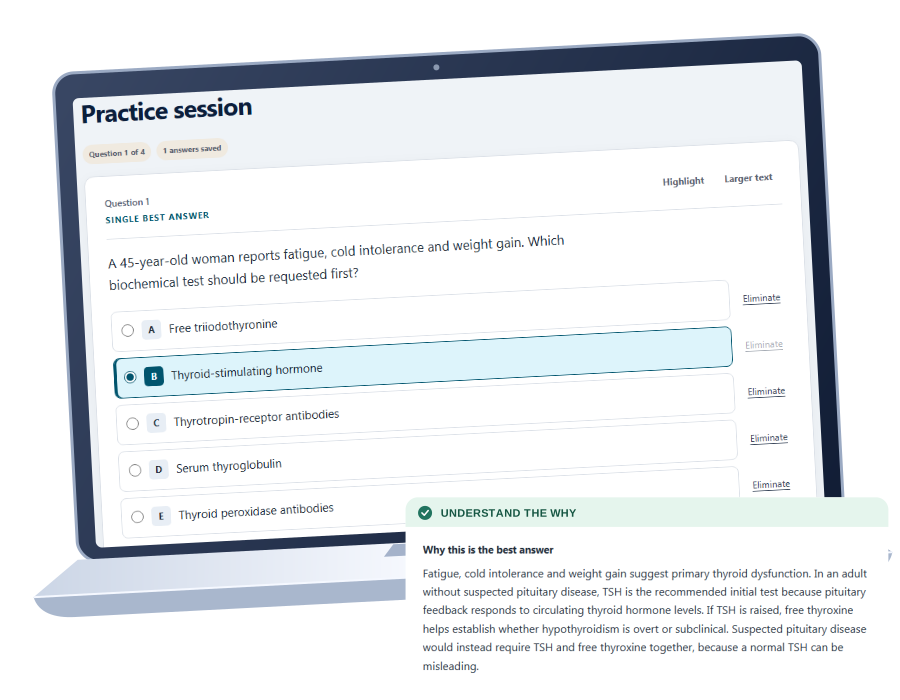
Read the reasoning for the answer and each option, with links to supporting sources.
Clinical Problem Solving and Professional Dilemmas, with focused practice sessions.
Save questions, revisit what needs work and track your progress in one place.
Try the question experience
Try all four MSRA question formats below, then reveal the answers and explanations. No account needed; your choices are not scored or saved.
Apply clinical knowledge to the decision in front of you.
CPS · Single Best Answer
Choose the single best response. This preview is not scored or saved.
A euvolaemic 76-year-old has sodium 124 mmol/L, low serum osmolality, urine osmolality 410 mOsm/kg and urine sodium 48 mmol/L. Thyroid, adrenal and renal tests are normal, and they take no diuretic. What is the most likely diagnosis?
Worked sample
This is hypotonic hyponatraemia: both sodium and serum osmolality are low. The expected response would be very dilute urine, yet urine osmolality is 410 mOsm/kg. Urine sodium is also above 30 mmol/L. In a euvolaemic patient with normal thyroid, adrenal and renal function and no diuretic use, this pattern supports inappropriate antidiuresis (SIAD). The diagnosis depends on the combined findings, not the sodium result alone.
Primary polydipsia (D) usually produces dilute urine, rather than the concentrated urine here. Pseudohyponatraemia (C) does not explain low measured serum osmolality. Heart failure (A) usually has evidence of fluid overload, while hypovolaemic sodium loss (E) requires evidence of volume depletion. Neither fits the stated euvolaemia as well as SIAD.
Interpret serum osmolality, urine osmolality, urine sodium and volume status together, and exclude adrenal, thyroid, renal and diuretic causes before diagnosing SIAD.
Selected sample from The MSRA Bank. Educational practice, not an official MSRA question or marking scheme.
CPS · Extended Matching
Response options may be used once, more than once or not at all.
For each airway or thoracic presentation, choose the investigation that best establishes the suspected diagnosis. An option may be used once, more than once or not at all.
Response options
Worked sample
Throat tightness and noisy inspiration at peak exercise, followed by rapid recovery, suggest exercise-induced laryngeal obstruction. Laryngoscopy during exercise can show the transient narrowing while symptoms occur. Resting assessment may miss it. Poor bronchodilator response supports considering this diagnosis, although asthma and laryngeal obstruction can coexist.
Daily purulent sputum, recurrent infections and persistent coarse crackles suggest bronchiectasis. Thin-section CT demonstrates the abnormal bronchial dilatation needed to confirm the structural diagnosis. A chest radiograph can be inconclusive, especially in milder disease; it does not exclude bronchiectasis.
Bronchodilator reversibility testing (A) assesses variable airflow obstruction, but does not demonstrate the laryngeal event in scenario 1. Sputum culture (G) is useful in scenario 2 to identify organisms and guide treatment, but cannot establish bronchiectasis. CT pulmonary angiography (C) addresses suspected pulmonary embolism, and dynamic bronchoscopy (F) assesses large-airway collapse; neither is the best match to these presentations. Repeating chest radiography (E) would not provide the definitive structural assessment required in scenario 2.
Match the test to the question: observe a transient laryngeal obstruction during exercise, and confirm suspected bronchiectasis with thin-section CT.
Selected sample from The MSRA Bank. Educational practice, not an official MSRA question or marking scheme.
Work through professional judgement, priorities and safe action.
PD · Ranking
Rank from 1 (most appropriate) to 5 (least appropriate), using each rank once. Judge the actions independently, not as a sequence.
You are a foundation year 2 doctor completing a workplace assessment after observing a colleague several times. You know the criteria and have clear examples of strengths and a recurring weakness. The colleague asks for positive comments only because their review is approaching.
Worked sample
A is strongest because the task is to provide an accurate assessment: it records both strengths and the recurring weakness using observed evidence. E is constructive and helps the colleague improve, but a private discussion alone does not fulfil the formal assessment task. D provides a useful fairness check, although you already have the evidence and understand the criteria. C avoids the assessment unnecessarily; knowing a colleague does not itself prevent an objective judgement. B is least appropriate because leaving a relevant weakness out of the formal record makes that assessment misleading, even if it is discussed privately.
The close distinction is between A and E: honest documentation is the central responsibility here, while supportive feedback helps the colleague act on it. Seeking a supervisor's view can be sensible if there is genuine uncertainty, but the stem says the evidence and criteria are clear. Judge each action on its own merits; this ranking is not a timetable for carrying them out.
Be fair, evidence-based and constructive. Supporting a colleague includes honest assessment of development needs.
Selected sample from The MSRA Bank. Educational practice, not an official MSRA question or marking scheme.
PD · Select three
Choose the three most appropriate actions. Deselect an action to change your selection.
You are a foundation year 2 doctor in an outpatient clinic. A recently bereaved colleague has become quiet and occasionally irritable since returning. You have observed no clinical errors or conduct that puts patients at risk.
Worked sample
B opens a private, compassionate conversation without assuming what the colleague needs. D offers help accessing confidential support if they want it. G provides practical assistance guided by their preferences. Together these address the individual situation while respecting privacy and autonomy. The stem supplies no patient-safety concern, so bereavement and occasional irritability alone do not justify removing the colleague from clinical work.
Annual leave (F) might be useful if the colleague wants it, but first explore their needs rather than assume time off is the answer. A general wellbeing session (H) could benefit the team but does not directly support this individual. Waiting for them to raise the subject (E) may leave an offer of help unspoken. Moving them away from patients before discussion (C) is disproportionate without a safety concern, and explaining their bereavement to patients (A) discloses private information without permission.
Offer private, practical support that the colleague wants. Escalate if evidence of a safety concern emerges, rather than assuming grief means unsafe practice.
Selected sample from The MSRA Bank. Educational practice, not an official MSRA question or marking scheme.
Keep practising
240 CPS questions and 50 PD scenarios with explanations. A free account is required.
An independent preparation resource from The Interview Bank. Not endorsed by NHS England, Pearson VUE or specialty recruitment organisations.